
Steiner Schools × IT Education
Created by Masashi Satoh | 11/14/2022
Marking the 10th Year of Teaching Computer Classes
Today, the world is overflowing with all kinds of information and new technologies. Due to the impact of the COVID-19 pandemic, ICT devices and other tools are rapidly being introduced into children’s educational environments. But really? Are children truly ready to receive these things? Doesn’t it make you feel uneasy?
At Yokohama Steiner School, computer studies are first introduced in 9th grade, when students begin their high school education. The reflections of children who have completed this learning show that this timing is by no means too late. Their budding thinking skills begin to grasp things that follow invisible paths. It seems to fit perfectly with the intellectual curiosity of children at precisely this stage.
The computer epoch learning program for 9th graders, which began in the 2013 academic year, reached its 10th iteration this year. Through repeated trial and error, and with advice from the homeroom teachers of the 9th grade classes each year, I believe we have established a reasonably satisfactory style over the past few years. Students unanimously expressed how much fun it was! However, what was particularly gratifying this time was hearing several students say, “I now understand why this school doesn’t introduce computers to younger students.”
Overview of Computer Studies Courses
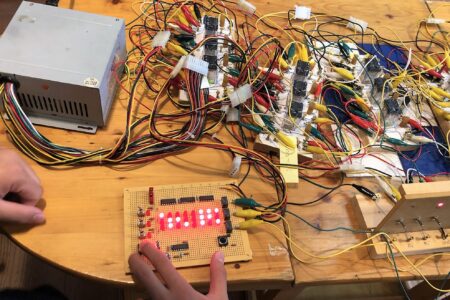
The 10-day epoch begins by touching on the history of computer development, then focuses on the main theme: building an adder (a device that performs addition in binary). Students start by creating a circuit using a combination of seesaws made from thick paper. This is to challenge the stereotype that computers are like human brains filled with electrical pulses. In fact, the mathematician Babbage, considered the first to conceive a feasible digital computer, envisioned a massive machine powered by a steam engine hissing and puffing steam.
Following this introduction, we tackle electromagnetic switches called relays. By combining these, we learn the principles of the adder while steadily building a large apparatus. Along the way, we experiment with clock circuits that give the computer its rhythm, memory circuits, and telegraph devices. The initially simple circuit gradually becomes increasingly complex.
The process of bringing the circuit diagrams drawn on the blackboard to life as tangled spaghetti-like wiring in the device was excellent training for these adolescents, helping them connect abstract concepts to tangible reality. Both boys and girls recorded in their Epoch Notebooks the joy of understanding the meaning behind the work they were doing.
“Even so, today was the most fun.”
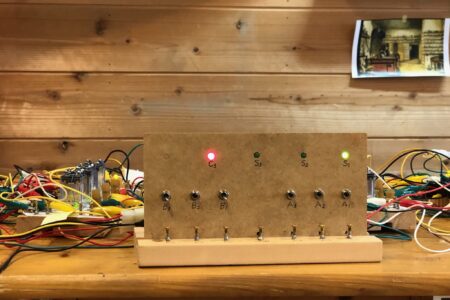
One team was struggling intensely with wiring a full adder capable of carry-over calculations. They checked the wiring repeatedly, reconnected it, and finally rebuilt it from scratch to test it, but it simply wouldn’t function properly. Later investigation revealed the cause was the battery. While it functioned fine when one or two relays were active, a particular calculation pattern required four relays to operate simultaneously, causing the battery to give out. Even with such a setback, one student wrote in their notebook, “Still, today was the most fun I’ve had so far.” It perfectly resonated with their mindset.
Finally, an adder capable of calculating three-digit binary numbers was completed, and we verified it by flipping switches back and forth. Then, as the finishing touch, we connected a homemade device called a sequencer. When it automatically fed in the combinations of numbers we had been setting manually just moments before, the device suddenly began to resemble a computer. One student wrote in his notebook, “For me, who understands how it works, it’s becoming a fun ‘toy’.”
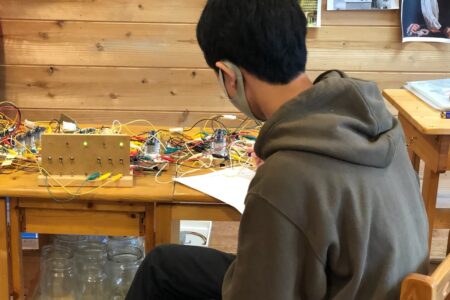
By building up to this point, the students’ understanding of how computers work advances rapidly. I rapidly explained the meaning of programs, how information like text, images, and sound is handled, how search engines work, and the mechanisms of input and output devices. And on the final day, it was time for the lesson the students had been eagerly awaiting: the internet.
Students’ long-awaited internet learning
After explaining packet communication, homepages, email, bulletin board services including SNS, and search engines, I had everyone sit in a circle. We assigned each person a country—Germany, China, Vietnam, Russia, Ukraine, and so on—and played catch with balls representing internet packet information. Messages flew back and forth across borders.
Yes. In the dawn of the internet, we all dreamed excitedly of a future where the world would be connected equally, ushering in a diverse and democratic online society. Yet the reality of the internet society that arrived is indeed convenient, but it also reinforces people’s biases, manipulates them, creates divisions, and daily produces extreme wealth disparity.
It is the human spirit that gives meaning to computers
At the end of my comment in a student’s epoch notebook, I wrote something along these lines: Computers themselves do not think or feel. It is the human spirit that ultimately gives meaning to the actions of computers.
Therefore, I wrote, if we wish to build a better computer society, we must relearn to stand firmly on the ground of human endeavors: ethics and law. Shouldn’t we ourselves also take a fresh look at the online society and our own ways of living here, consider what we can do for our children’s future, and take action?
9th Grade Computer Epoch Class Teacher, Masashi Satoh
✦ ✦ ✦
This article is a translation of an article published on the Yokohama Steiner School website.

コメント