Learning Data Models
Created by Masashi Satoh | 12/09/2025
- Shaping the spine of the ICT curriculum in Waldorf education
- The History of Computers(Currently being produced)
- Details on Constructing an Adder Circuit Using Relays
- Internet
- Learning Data Models
- Learning Programming and Application Usage Experience(Currently being produced)
- Human Dignity and Freedom in an ICT-Driven Society(Currently being produced)
Introduction
This article supplements the main section “Shaping the spine of the ICT curriculum in Waldorf education.”
The foundational learning of computer and internet technology, centered around building a multi-digit adder as introduced in the previous section, is a highly comprehensive and valuable learning experience. However, this alone does not complete the study of computer technology.
The learning described above leaned more toward the hardware aspects of computers and placed a strong emphasis on viewing computers as devices that execute processes along a timeline.
Since computers are designed to process real-world phenomena as information, we must also examine how that information is handled internally within the computer.
In digital computers, information such as numbers and characters is represented within patterns of 0s and 1s by organizing sequences of 0s and 1s in memory space, which can be described as a spatial expanse. While learning about processes deals with temporal elements, learning about data structures deals with spatial elements. It is only through learning both of these two aspects that we can begin to grasp the full picture of computer technology.
Let’s call the study of the techniques for designing this memory space the study of data models.
I recommend that students learn the data models introduced here before they touch a personal computer, use applications, or create programs.
This learning is precisely what reveals the connection between the world’s phenomena and computers. It is the key to understanding what happens behind applications and the foundation that gives programs clarity. This material will also be very useful in helping adolescent students connect with the world through the power of their own thinking.
Which types to include in the curriculum?
If we were to list the data types covered within the limited time available in Waldorf high school, I believe they would be restricted to integer types, floating-point types, string types, pointer types, and arrays.
I will discuss this in detail later, but I believe the significance of each of these learning experiences can be broadly positioned as follows.
- Integer type: The prototype for all types. Every type achieves a wide range of concepts and data management mechanisms by extending or combining the meaning of the integer type.
- Floating-point type: This concept offers an intriguing model of how humans perceive and describe the world. To draw an analogy with visual perception: just as human vision has limitations — requiring us to step back to see large objects and move closer to see small ones — the floating-point type operates similarly. By adjusting the exponent part to fit neatly within the resolution of the mantissa part, it enables programs to handle a wide range of numerical values (normalization).
- Character and String Types: Understanding how computers process characters and strings to represent natural language is a fascinating area of study. Students will be excited to learn techniques for linking concepts to IDs to make them operable, as well as methods for handling dynamic structures with variable lengths.
- Pointer type: A fundamental mechanism for imparting dynamic characteristics to data structures. This mechanism is also utilized in string manipulation. When a computer behaves as if it were a living thing, the pointer type is likely at work behind the scenes.
- Arrays: Arrays are best introduced as the mechanism that enables spreadsheet applications.
Through these lessons, students understand how memory is partitioned by humans, assigned inherent meaning, and how phenomena like numbers and characters are represented and manipulated. This learning experience truly showcases the essence of human-centered computer technology education.
Students can discover both the depth and fascination of representing world phenomena as data, while also recognizing its limitations and pitfalls. Moreover, this learning encompasses all the fundamental elements necessary to grasp the essence of search engines, generative AI, blockchain technology, and more.
And it is through these three elements—data model, process, and operation algorithms—that a program is completed. Therefore, I believe learning about data models is an essential element of education.
Now, let’s take a closer look at what kind of learning can be developed from each individual data type.
Before introducing this learning activity, review the memory mechanism previously covered in the adder unit. To understand how memory is arranged inside a computer, you may want to run the sequencer device again. It is important to progress through this learning activity with this image in mind.

Preparation
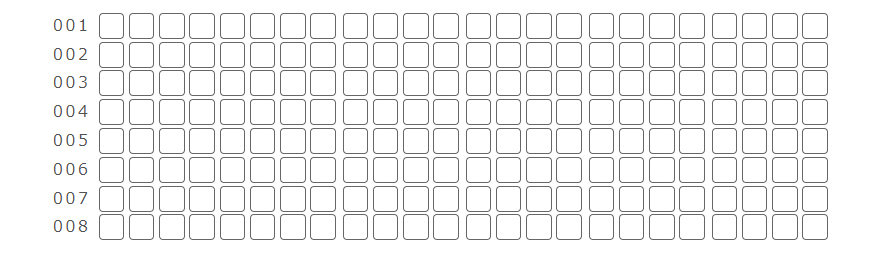
bit, byte, word, and memory map image
First, as preparation, briefly explain the units of bits and bytes to the students.
Needless to say, a bit is the smallest unit of information that a single memory cell can hold. It can hold one of two states: 0 or 1.
The definition of a byte originated with IBM’s SYSTEM 360. It became established because 8 bits were both necessary and sufficient to comprehensively handle the Latin alphabet, numerals, and symbols, enabling the representation of 256 patterns.
We also explain to students that binary information is easier to handle in multiples of 2, and that since hexadecimal notation is used to make this more understandable for humans, multiples of 4 bits — equivalent to one hexadecimal digit — are suitable. Explain that these circumstances led computers to structure memory in widths that are multiples of 8 bits.
Mention that a single addressable block of memory is called a word, and show a conceptual diagram of the computer’s memory structure on the blackboard.
001 ____
002 ____
003 ____
004 ____
005 ____
006 ____
007 ____
008 ____
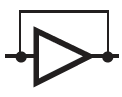
Each square in the upper grid contains a positive feedback device discussed in the “Clock and Memory” section, arranged in a row. Each square in the upper grid contains a positive feedback device discussed in the “Clock and Memory” section, arranged in a row. It is crucial for students to clearly visualize these memory squares lined up in columns within the computer.
It is crucial for students to clearly visualize these memory squares lined up in columns within the computer. The operation of a computer means that this vast expanse of semantically blank memory cells is ordered and woven into patterns imbued with meaning by humans.
It is crucial that students can clearly visualize the situation where memory cells are arranged in rows within the computer.
Once you can visualize the concept of a memory array, we’ll also discuss the physical layer.
Memory devices in everyday life, understanding concepts
First, let’s focus on records within our daily lives. Notebooks, books, and similar items have existed as recording devices long before computer technology emerged.
It’s crucial to realize that the characters written in notebooks or the printed text in books are digital information. Here, we discuss the nature of digital information as data that records symbols associated with specific concepts.
Even if a book gets wet or torn, the information itself doesn’t degrade as long as the written characters can be identified. Because printed characters are digital information. However, when what is printed in a book is an image like a photograph, the information recorded as a collection of analog quantity changes cannot avoid degradation. It is crucial to understand this difference clearly.
Recording numerical information by storing values through the presence or position of beads, as seen in abacuses and sorobans, has been practiced since ancient times. Like writing, this is a form of digital memory that associates the state of an object with the concept of number. Computer memory, in its fundamental mechanism, differs little from the abacus or soroban. Indeed, Babbage’s Analytical Engine and Turing’s Z1 formed their memory devices using mechanisms not vastly different from mechanically moving the beads of an abacus.
Now, the keyword “concept” has appeared frequently up to this point. Taking this opportunity to focus on our internal activities and discuss with students what a concept actually is will make the overall learning experience more meaningful.
Humans transform representations received from the world through their senses into their own concepts through the workings of thought. When encountering that object again, thought immediately calls up the corresponding concept, revealing what it is. This is the state in which we know something.
Even when not directly engaged with an object, we can recall its concept, add new thoughts about it, or manipulate it. In daily life, we rarely consciously notice this mental activity, yet this is how we constantly engage with the world.
When discussing AI in particular, we must engage with it grounded in a solid image of the concrete nature of human inner activity as a spiritual being. We should not commit the folly of treating human mental activity with mechanical models like AI.
Now, whether it’s text or numbers, the information processed by computers does not inherently exist within the computer itself. Recall that what the computer treats as if it were a numerical value is, in reality, merely a combination of states capable of taking two possible values. (See “Details on Constructing an Adder Circuit Using Relays”)
The common understanding that computers operate using binary numbers is nothing more than an illusion.
To make computers behave as if they were manipulating binary numbers, humans established a correspondence between certain patterns and the concept of binary numbers, and constructed logic circuits enabling pattern manipulation consistent with the mathematical concept of binary numbers. Nevertheless, the fact remains that what the computer, as a machine, actually operates on are patterns of two states, as described earlier.
Thus, it becomes clear that a computer is a device that links patterns and concepts, operates on them, and extracts the corresponding concept from the resulting pattern as a meaningful outcome for humans. It is fundamentally impossible for a computer to possess concepts and operate on them as meaningful entities.
Always keep in mind that it is humans who connect computer behavior with concepts as you proceed with your lessons.
Implementation of Memory Devices
After this introduction, briefly introduce students to the mechanisms that realize the memory systems prevalent today. For example, something like the following. Feel free to adjust the content based on the time available and the level of student interest.
- Semiconductor memory (Static RAM, Dynamic RAM, Flash memory)
- Magnetic memory (FDD, HDD)
- Optical memory (CD, DVD, Blu-ray)
If students show strong interest, you could connect this to computer history by introducing ABC’s capacitor drum memory, UNIVAC I’s mercury delay line memory, and if necessary, the CRT memory in the Baby computer. Explain how the core idea behind these early designs lives on in today’s mainstream dynamic RAM. This simple idea was born with the goal of increasing memory capacity at low cost, both then and now.
Let’s confirm with students that this accumulation of innovations has enabled the low-cost use of vast amounts of memory, allowing massive amounts of information to flow before our very eyes even at the everyday level.
Flash memory, now the mainstream non-volatile memory, should also be touched upon. Even without delving deeply into its mechanisms, it’s worthwhile to observe how pervasive its use is in our daily lives.

And as a review of what we learned in the “Clock and Memory” section, let’s confirm that all these devices are positive feedback systems utilizing the hysteretic characteristics inherent in the devices and their physical properties. (See diagram of square building blocks)
For example, while the capacitors themselves in dynamic RAM that hold information do not possess the ability to retain data for long periods, when viewed as part of the entire system that periodically refreshes data, they form a positive feedback circuit.
The hysteresis characteristic with this threshold and the positive feedback characteristic that seeks to reinforce the polar tendency of information possessing polarity are what distinguish analog recording from digital recording.
Once this groundwork is laid, we can proceed to learning about various data types.
Integer type
First, let’s examine the data model for integer types, which represent simple numerical information. Integer types are the most fundamental data types. They form the basis for all type structures, and while simple, they hold profound elements for learning.
Starting with the relationship between bit width and the range of values that can be handled, there are several elements to cover regarding integer types, such as how negative numbers are represented, the concept of two’s complement, and overflow.
Additionally, integers can be used to assign an ID-like property to events or concepts, enabling their handling by computers. This is also a very important aspect, but it will be covered in the section on character types and string types, which deal with manipulating the concept of characters using IDs.
Here, we will examine the properties of integer types as the fundamental type for representing numbers.

Floating-point type
Character and String Types
Character types are an extremely important mechanism that provides computers with an interface to humans through natural language. However, as already mentioned in the section on “Fundamentals of Information Processing,” the principle itself is very simple.
Here, we will delve deeper and learn about the dynamic mechanisms of string types, which handle groups of character types as strings.
pointer type
Arrays
In closing
How does that sound? I hope you’ve gained a real sense of the depth and importance of learning data models.
Through what we’ve learned so far, we’ve reached the very essence of computers as devices. With this foundation firmly established, it’s time to move on to applications. Well done.
- Shaping the spine of the ICT curriculum in Waldorf education
- The History of Computers(Currently being produced)
- Details on Constructing an Adder Circuit Using Relays
- Seesaw Logic Elements
- Clock and Memory
- The Origin of the Relay and the Telegraph Apparatus
- About the sequencer
- About the Battery Checker(Currently being produced)
- Internet
- Learning Data Models
- Integer type
- Floating-point type
- Character and String Types
- Pointer type
- Arrays
- Learning Programming and Application Usage Experience(Currently being produced)
- Human Dignity and Freedom in an ICT-Driven Society(Currently being produced)


コメント