The Origin of the Relay and the Telegraph Apparatus
Created by Masashi Satoh | 12/09/2025
- Shaping the spine of the ICT curriculum in Waldorf education
- The History of Computers(Currently being produced)
- Details on Constructing an Adder Circuit Using Relays
- Internet
- Learning Data Models
- Learning Programming and Application Usage Experience(Currently being produced)
- Human Dignity and Freedom in an ICT-Driven Society(Currently being produced)
Introduction
This article supplements the section “The Mechanism of Telegraphs—Fundamentals of Transmission” within the main article “Detailed Construction of a Relay-Based Adder Circuit.”
Here, to gain a basic understanding of internet technology that we will learn at the end of this course, we will tackle the transmission of information using telegraph technology. This learning also connects to understanding the origin of the name for the relay devices we will use to build the adding machine, so I believe it is an excellent learning experience.
Telegraph technology
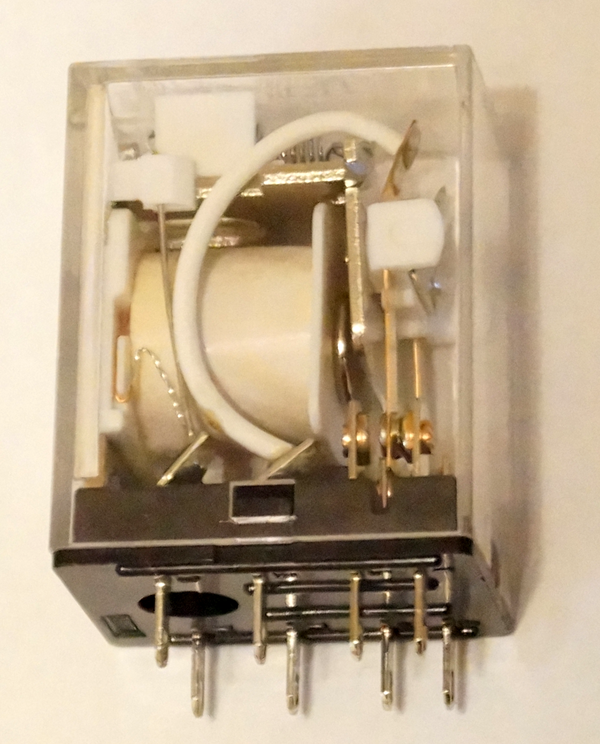
To introduce this lesson, I tell my students:
“So far, we’ve used relays to build various logic devices. But why are they called relays? When we say ‘relay,’ we think of passing the baton in relay races, right? How did they get such a curious name? Today, we’ll explore that.”
In modern times, people use the internet and telephones to converse daily, exchange information, and enrich their work and lives. However, not so long ago, there was no technology to converse with people far away. Before the invention of the telephone, the device widely used was the telegraph.
The telegraph system was simple: connect a switch called a key to a power source, run wires from it, and connect to a buzzer device installed at the location where you wanted to deliver the information. Since the earth conducts electricity, burying one end of the power source—such as a copper plate—in the ground meant communication was possible using just a single wire.
Using this device, it was possible to send Morse code—a system assigning letters to combinations of short and long sounds—to deliver information instantly to a distant recipient.
The Role of Relays in Telegraph Systems
However, there was one problem with this approach. While wires made of materials like copper certainly conduct electricity well, they still have a slight resistance. As electricity travels long distances, power is lost as heat.

This is just an example, but it happened that a signal originally sent at 50V would arrive at its destination at half strength, causing unintended operation. That’s when the device known as the relay was invented.
Relay stations are placed at distances where power is not completely lost due to wire resistance. Power sources and relays are connected there, and the received signal activates the relay’s electromagnet. This allows the same signal to be sent out again at the original voltage.
The way the signal is passed from relay station to relay station until it reaches its destination is what led to the term “relay.”
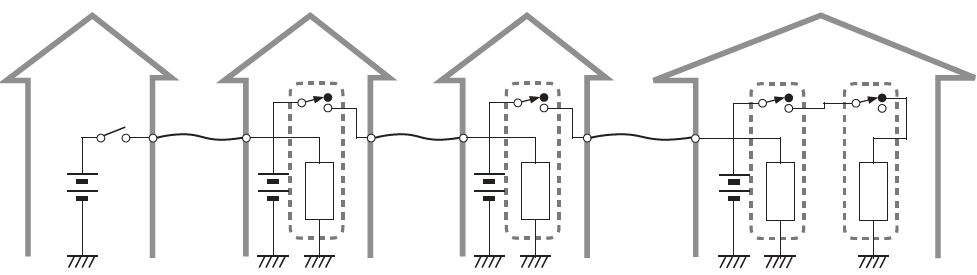
Telegraph Experiment
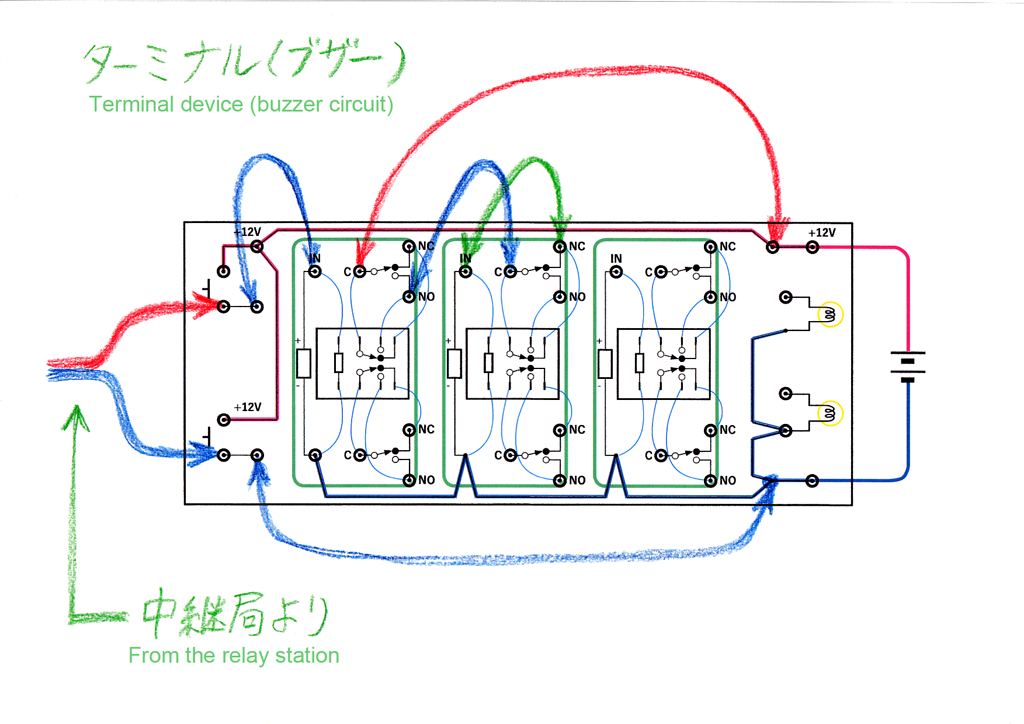
After discussing this topic, we will use the relay workbench to actually build a telegraph device. We’ll work in several groups. Each island will serve as a relay station, connected by a long cable. Since the classroom has no ground, we’ll use a two-wire cable. Position the groups to simulate relaying information from one end of the classroom to the other.
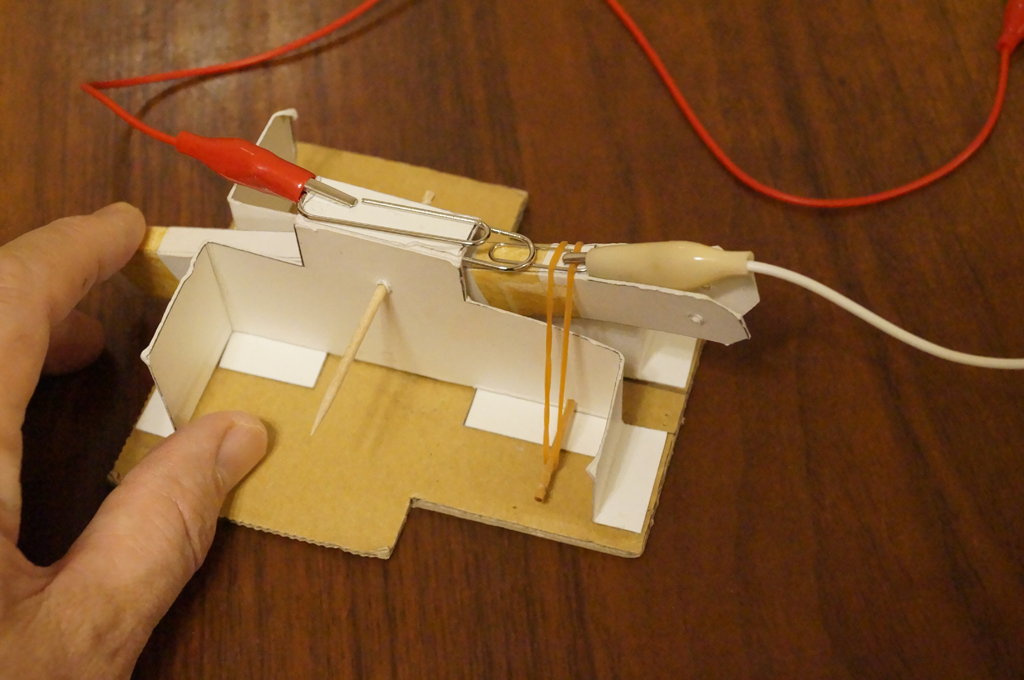
At one end, connect the key switch and battery, and at the opposite terminal, form a buzzer circuit. I’m repurposing the device used for learning seesaw logic elements to create the key switch. For the buzzer, I’m using the negative feedback circuit we just learned. The experience of immediately applying what you’ve learned is pedagogically valuable.
Unlike learning logic circuits or adders, here you don’t need to deepen your understanding of the circuit while wiring it. Prepare the wiring diagram in advance so students can wire it while referring to it.
Once each device has been tested, connect the relay stations and begin communication. It would be fitting to deliver a solemn, opening-ceremony-like speech before having the students operate the keys. When the students’ excitement reaches its peak, clicking sounds occur at each relay station, and a buzzer sounds at the opposite end—then the experiment is a success.
If the experiment goes well, we’ll send a simple Morse code message to confirm that information transmits properly. Simple codes like SOS are best. (The Morse code SOS signal is so famous that you could share all sorts of stories about it.)
Finally, it would be beneficial to revisit the blackboard and visually confirm how electrical signals of varying lengths travel through thin wires and reach their destination, thereby reinforcing the students’ understanding.
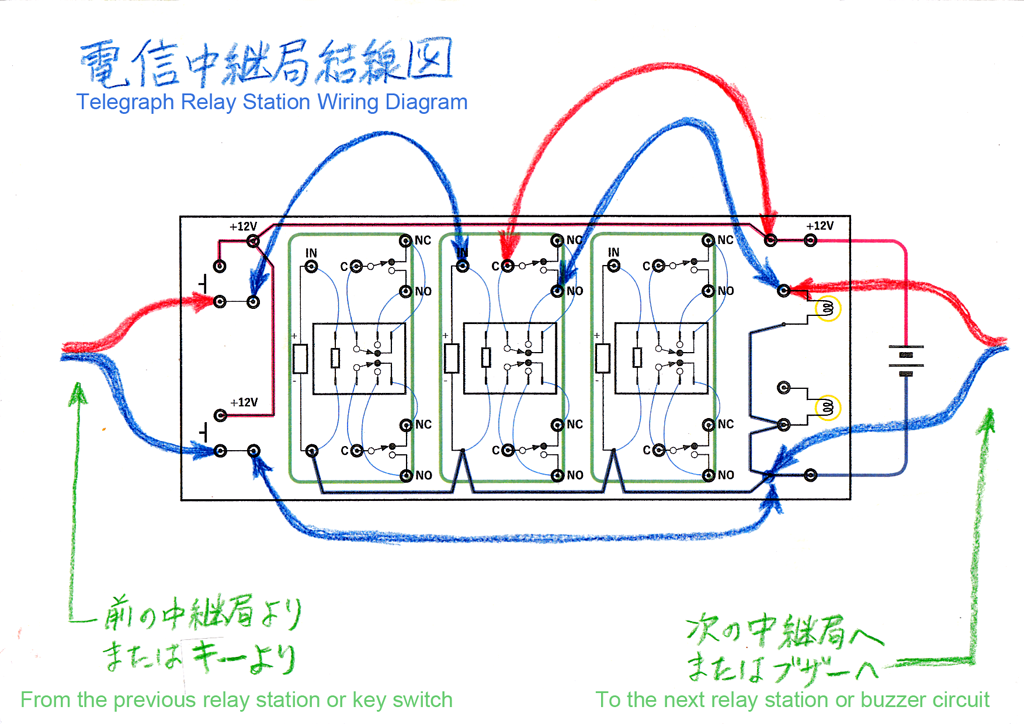
In closing
This learning activity is simple enough to complete in half the time of a main lesson period, yet it is extremely helpful in enabling students to grasp the fundamental concept of data transmission that forms the basis of internet learning.
In learning about the internet, teachers who are mindful of the images formed during telegraph studies can guide students toward better learning.
- Shaping the spine of the ICT curriculum in Waldorf education
- The History of Computers(Currently being produced)
- Details on Constructing an Adder Circuit Using Relays
- Seesaw Logic Elements
- Clock and Memory
- The Origin of the Relay and the Telegraph Apparatus
- About the sequencer
- About the Battery Checker(Currently being produced)
- Internet
- Learning Data Models
- Integer type
- Floating-point type
- Character and String Types
- Pointer type
- Arrays
- Learning Programming and Application Usage Experience(Currently being produced)
- Human Dignity and Freedom in an ICT-Driven Society(Currently being produced)